Uneven heat across the grate, one side scorching and the other barely warm. He cleared blocked ports with a reamer rather than a wire brush, checked the regulator flow and rebalanced the burners.
Padraig S.2026-07-16
Independent Viking service · St. Johns County, Florida
$80 diagnostic, credited to the repair
outdoor
Built-in and cart grills, side burners and rotisseries. Ignition, gas delivery, burner replacement and coastal corrosion.
Reviewed 2026-08-08
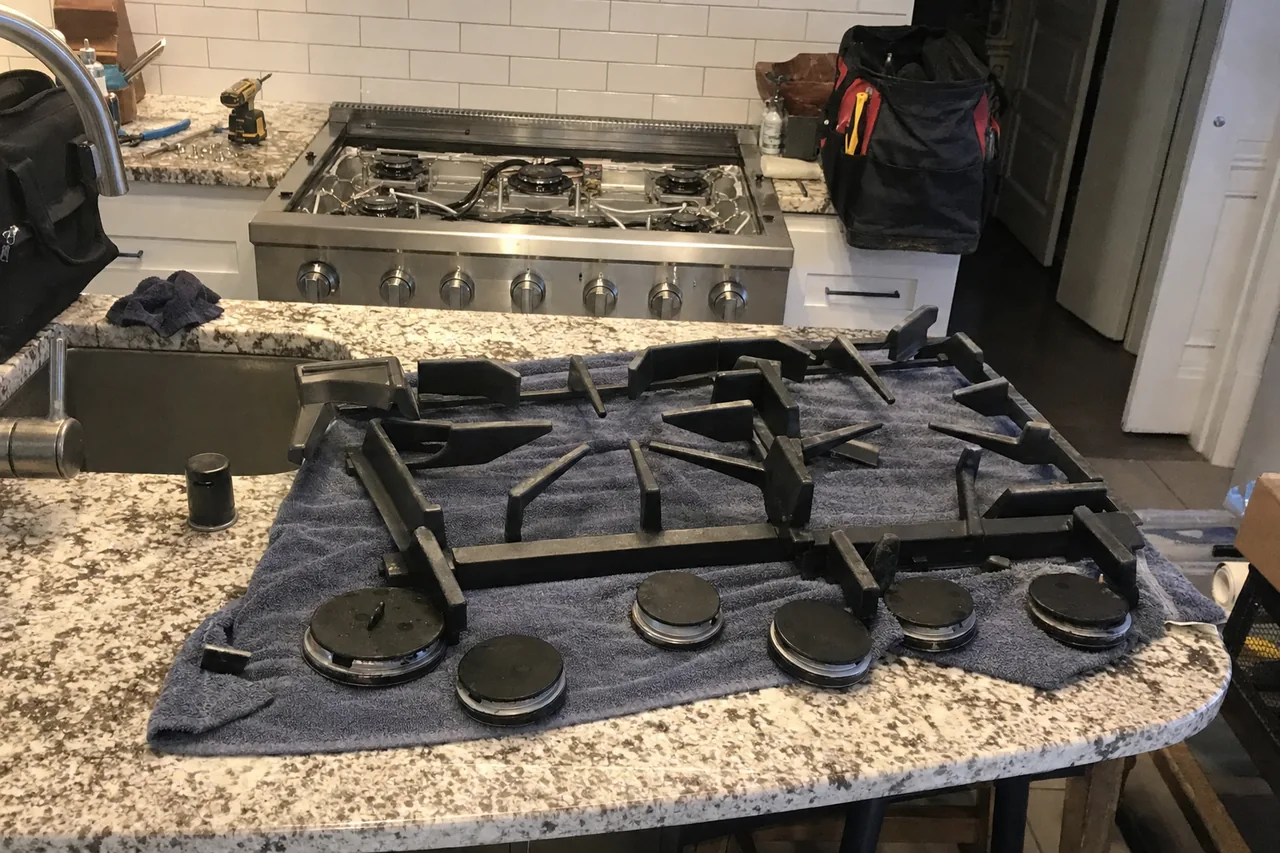
An outdoor kitchen in St. Johns County lives in the worst environment on the property. It is outside, it is often within a mile or two of open water, and it gets used hard for a season and then ignored. Nearly every grill we open in 32080 or 32084 tells the same story in the same order.
| Stage | What you see | Underlying cause |
|---|---|---|
| First | Uneven flame along one tube | Ports partly blocked by carbon and salt crust |
| Then | One burner dead, spark still present | Burner tube perforated, gas leaving before the ports |
| Then | Weak yellow flame everywhere | Regulator, orifice restriction, or a supply problem |
| Then | No spark at all | Electrode cracked, module corroded, battery or lead failed |
| Last | Everything loose | Fasteners and hinges rusted through |
Burners are consumables on the coast. A stainless tube sits directly in a chloride-rich, high-temperature environment, and once it perforates on the underside the flame pattern goes wrong before the hole is visible. We replace burners as a set when one has gone, because the others are the same age in the same air.
A grill that lights weakly on every burner at once is a supply problem, not five simultaneous burner failures. On a propane installation the most common cause is the excess-flow device in the tank valve. Opening the cylinder valve quickly with a burner valve already open trips it, and the grill then runs at a fraction of its gas rate no matter what you do at the knobs. Closing everything, waiting, and reopening the cylinder slowly with all burner knobs off resets it. It costs nothing to try before we come out.
On natural gas, a weak flame across the whole appliance points to line sizing or a shared load — a grill teed off a run that also feeds a pool heater will starve when both call at once. We check static and working pressure at the appliance rather than assuming.
Orifices are sized for one fuel. A grill converted between propane and natural gas without the correct orifice set will either soot heavily or lift its flames off the ports. We do not improvise conversions.
Salt aerosol does not need a wave. It carries inland on the prevailing wind and settles as a hygroscopic film that holds moisture against metal for hours after the surface looks dry. On a grill that means:
Rinsing the exterior and the cart interior with fresh water after a blow, and covering the grill when it is cold and dry rather than warm and damp, changes the service interval more than any product on a shelf.
The grill that will not start in October has usually been sitting since June with a cover on it in the wettest months of the year. Wasps and mud daubers block venturi tubes, which produces a flame that burns back inside the tube with a distinctive roar. That is a safety issue and we shut the appliance down until the tube is cleared or replaced.
Flat $80 diagnostic, credited toward the repair. Written estimate before any part is ordered. Genuine OEM parts, 90 days labour, 365 days parts. We do not carry out gas work we cannot leave safe.
A band, not a single number: the firm figure is written down after the appliance has been opened and measured, and a range is what you can act on before that. Parts and labour together, fitted, for viking outdoor grills and built-in gas.
| Repair | Typical range |
|---|---|
| Diagnostic visit | $80 flat |
| Igniter or burner assembly | $210–$560 |
| Control board or touch panel | $410–$980 |
Flat $80 diagnostic covering the visit and the full diagnostic sequence, credited toward the repair once you approve the work.A written estimate comes before any part is ordered or any labour is billed. The whole published table. Worth fixing, or worth replacing.
The visit is a flat $80 diagnostic, credited toward the repair once you approve it. The repair itself lands in the bands published on this page — igniter or burner assembly $210–$560; control board or touch panel $410–$980 — so $80 to $980 covers the work described here, parts and labour together. The firm number is written down after the appliance has been measured, never before.
Igniter or burner assembly work runs $210–$560 fitted, which against a $6,500–$14,500 appliance is never the replacement argument. Clicking without a flame is usually an electrode, a cap seated a millimetre off its register, or one dead channel on the spark module — the cheapest outcomes in this book.
Because the same complaint has more than one cause, and the causes do not cost the same. A written estimate comes before any part is ordered or any labour is billed. If the measurement rules out the expensive end, you see that on the estimate before you decide anything.
90 days on our labour and 365 days on the parts we supply. Genuine OEM parts. A return visit on the same fault inside the term carries no second diagnostic and no trip charge.
Ring the bench and describe the symptom. A question that cannot be answered on the telephone is a question that needs a meter on the appliance, and we would rather say so than sell a visit to find out.
Uneven heat across the grate, one side scorching and the other barely warm. He cleared blocked ports with a reamer rather than a wire brush, checked the regulator flow and rebalanced the burners.
Padraig S.2026-07-16
The lid gauge read wildly high so everything came off burnt. He compared it against a probe, confirmed the gauge was wrong and swapped it, then showed me where to sit a probe for a reading worth trusting.
Marguerite O.2025-10-08
The rotisserie motor died halfway through a cook and the grill light went with it. He found the fault in the wiring where the harness passes through the cart rather than in the motor, repaired it, and saved me a part I did not need.
Marcus H.2025-09-30
Flat $80 diagnostic, credited toward the repair when you approve the work. A written estimate comes before any part is ordered or any labour is billed.
90 days on labour, 365 days on parts, genuine OEM parts only. Calls placed after hours are returned the next working morning.