The range works again after a new igniter, so the repair itself was sound enough. What I did not care for was how little got explained while it was going on. I had to ask twice what had actually failed and why it mattered.
Kathy V.2025-12-05
Independent Viking service · St. Johns County, Florida
$80 diagnostic, credited to the repair
range
Sealed burners, infrared broilers, convection bake and door hinges on Viking professional ranges and rangetops.
Reviewed 2026-08-01
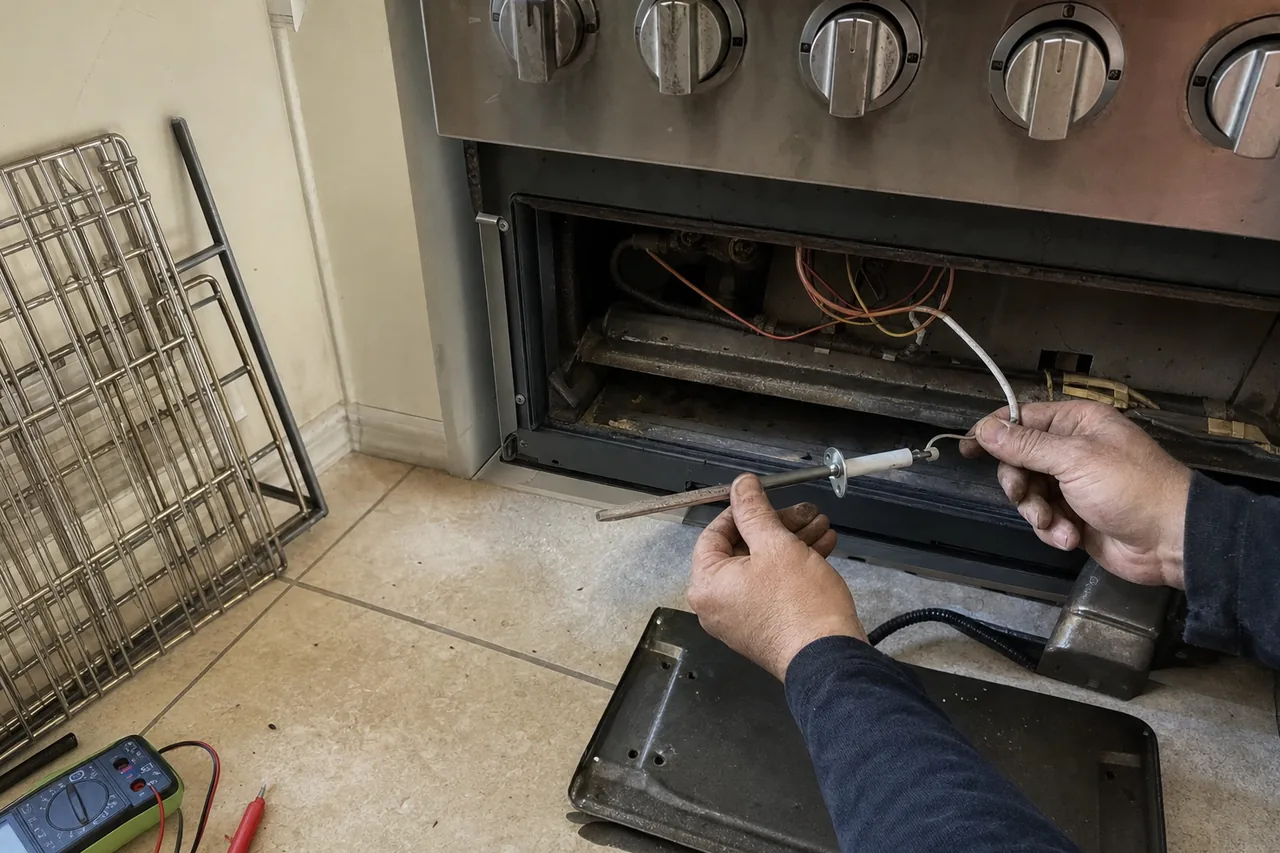
A professional range is usually the reason a kitchen was laid out the way it is, so a failure is not a small inconvenience. Almost everything that comes off the truck for one of these falls into three groups: ignition, heat control, and the door.
| What you see | Usual cause | What we check |
|---|---|---|
| Clicks, will not light | Fouled or cracked electrode | Spark gap, insulator for tracking |
| Clicks on every burner when one is turned | Normal on a shared module | Nothing — this is by design |
| One burner dead, others fine | Cap seated wrong, blocked port | Cap alignment, port clearance |
| No spark anywhere | Spark module or its supply | Voltage at the module, output per channel |
| Lights then drops out | Flame supervision or a weak flame | Flame signal, gas pressure at the appliance |
A burner that clicks without lighting is most often a fouled electrode, a cap seated a millimetre off its register, or a spark module that has lost one channel. Caps are the cheapest thing on that list and the most commonly at fault — a cap put back after cleaning without seating into its locating feature will spark to the wrong place indefinitely.
Flames that burn yellow or lift off the cap are a mixture problem: a blocked port, a shutter out of adjustment, or an orifice that does not match the fuel. Orifices are sized for one gas. A range converted between natural gas and propane without the correct set will either soot or lift, and we do not improvise those conversions.
Oven complaints are measured, never guessed. A probe in the cavity for a full preheat and at least two cycling periods separates three faults that look identical from the kitchen: a sensor that has drifted, an element or burner that is not delivering full heat, and an oven that is genuinely accurate but sitting in a cabinet with a blocked air path. Only the first two are parts.
Convection adds its own list. A fan that has slowed, a blade fouling the baffle, or a motor that has lost a winding will all produce even readings on a probe and uneven results on the food, because the measurement is right and the air distribution is not.
A door that will not close square pulls the gasket open at one corner and lets the cavity leak. That reads as a slow preheat, a cold zone at one side, and scorched cabinetry above the handle. Hinges and their springs take a set over years of a heavy door being dropped rather than closed. We check the appliance for level before adjusting the hinges, because a door forced square against a twisted chassis will not stay there.
Downtown and Anastasia Island kitchens add a physical constraint. Cabinet openings in houses from the 1900s to the 1930s were not cut for a 36-inch professional range, and the clearance behind the appliance is often less than the installation instructions assume. That affects service access and, more importantly, how hot the surround and the appliance’s own control pocket get. A range with restricted rear clearance will keep producing electrical faults until the opening is corrected, and we would rather tell you that than sell you the same part twice.
The other local factor is gas supply. A professional range at full rate — every surface burner plus the oven — draws more than an older, undersized line will carry. The signature is an appliance that works perfectly one burner at a time and goes weak when the whole thing is in use. That is a pipe question for a licensed gas fitter, not a parts order.
Flat $80 diagnostic, credited toward the repair when you approve the work. A written estimate before anything is ordered. Genuine OEM parts, 90 days on labour and 365 days on parts. Nothing gets replaced on suspicion.
A band, not a single number: the firm figure is written down after the appliance has been opened and measured, and a range is what you can act on before that. Parts and labour together, fitted, for viking range and rangetop repair.
| Repair | Typical range |
|---|---|
| Diagnostic visit | $80 flat |
| Igniter or burner assembly | $210–$560 |
| Oven thermostat or heating element | $180–$610 |
| Control board or touch panel | $410–$980 |
Flat $80 diagnostic covering the visit and the full diagnostic sequence, credited toward the repair once you approve the work.A written estimate comes before any part is ordered or any labour is billed. The whole published table. Worth fixing, or worth replacing.
The visit is a flat $80 diagnostic, credited toward the repair once you approve it. The repair itself lands in the bands published on this page — igniter or burner assembly $210–$560; oven thermostat or heating element $180–$610; control board or touch panel $410–$980 — so $80 to $980 covers the work described here, parts and labour together. The firm number is written down after the appliance has been measured, never before.
Igniter or burner assembly work runs $210–$560 fitted, which against a $6,500–$14,500 appliance is never the replacement argument. Clicking without a flame is usually an electrode, a cap seated a millimetre off its register, or one dead channel on the spark module — the cheapest outcomes in this book.
Because the same complaint has more than one cause, and the causes do not cost the same. A written estimate comes before any part is ordered or any labour is billed. If the measurement rules out the expensive end, you see that on the estimate before you decide anything.
90 days on our labour and 365 days on the parts we supply. Genuine OEM parts. A return visit on the same fault inside the term carries no second diagnostic and no trip charge.
Ring the bench and describe the symptom. A question that cannot be answered on the telephone is a question that needs a meter on the appliance, and we would rather say so than sell a visit to find out.
The range works again after a new igniter, so the repair itself was sound enough. What I did not care for was how little got explained while it was going on. I had to ask twice what had actually failed and why it mattered.
Kathy V.2025-12-05
One surface burner would spark on and on without ever catching. He measured the electrode gap, cleaned a clogged port and had it lighting in minutes, then went over the other burners while he had the top apart. Nothing needed replacing.
Sofia L.2026-07-21
The simmer setting was not simmering and everything scorched. He adjusted the low flame screw on each burner, then held a pan of water at a bare simmer on all of them before he called the job done.
Solveig T.2026-05-09
Flat $80 diagnostic, credited toward the repair when you approve the work. A written estimate comes before any part is ordered or any labour is billed.
90 days on labour, 365 days on parts, genuine OEM parts only. Calls placed after hours are returned the next working morning.