Filters rattled and the hood whined at every speed. He showed me the baffles had been refitted the wrong way round, turned them, then cleaned the housing and checked the blower at each setting.
Orson W.2025-11-05
Independent Viking service · St. Johns County, Florida
$80 diagnostic, credited to the repair
ventilation
Wall, island and liner hoods with internal, inline or remote blowers. Extraction, controls, lighting and duct faults.
Reviewed 2026-08-07
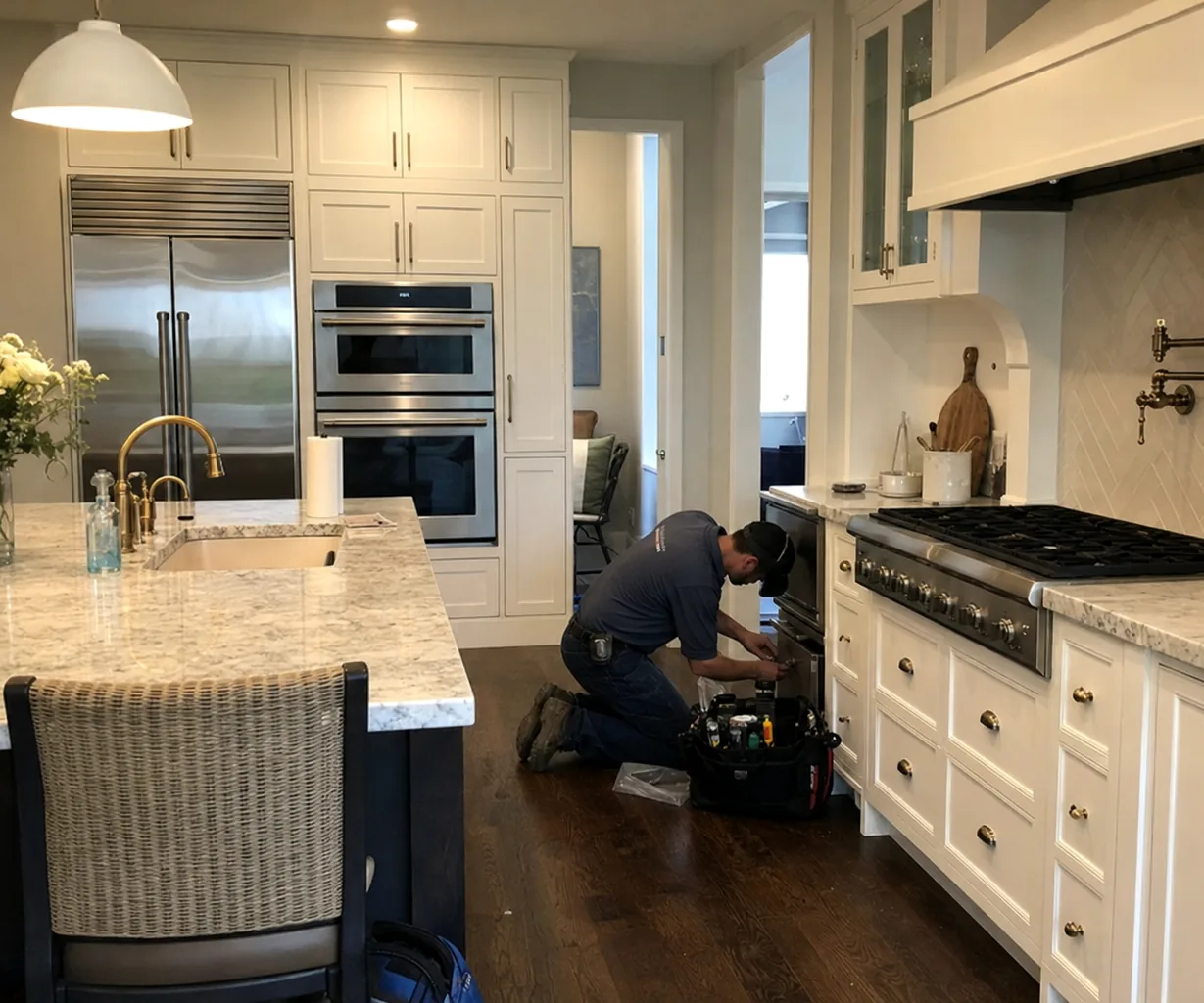
A hood is judged on one thing: whether the plume leaves the room. Almost every call that starts with the hood is not strong enough turns out to be one of four things, and only two of them are inside the hood.
| Cause | Evidence | Fix |
|---|---|---|
| Loaded filters | Baffles heavy, grease bridging the vanes | Degrease or replace filters |
| Duct restriction | Whistle on high, long flexible run, crushed elbow | Correct the duct, not the hood |
| No makeup air | Doors pull hard, hood quietens when a window opens | Provide makeup air |
| Blower fault | Noise, one speed only, hot motor | Motor, capacitor, or speed control |
The third one surprises people. A high-output hood cannot exhaust air the house cannot replace. Residential code requires a makeup-air provision once a hood is rated above 400 CFM, and a professional-grade hood over a professional range is comfortably past that. In a well-sealed newer house in SilverLeaf or Murabella, running the hood on high with everything shut simply pulls the house into negative pressure — the blower spins at full speed and moves a fraction of its rating. Crack an exterior door and the same hood suddenly works. That test costs nothing and tells us where the fault is not.
Internal, inline and remote blowers fail differently. An internal blower puts its motor in the grease stream, so the wheel loads up unevenly and the whole hood vibrates; balance returns once the wheel is cleaned, and if it does not, the bearing has gone. An inline blower in the attic runs in a hot, humid space and its capacitor ages faster than the motor does — a unit that hums and will not start, or that only runs on one speed, is usually a capacitor before it is a motor. A remote roof-mounted blower on the coast has the hardest life of all.
We test motor windings and capacitance rather than swapping the assembly on suspicion, because a remote blower is the most expensive part on the hood.
The damper is a set of light aluminium flaps that open on airflow and fall shut when the blower stops. In 32080, 32084 and the beachside ZIPs, salt aerosol and condensed grease combine into a film that gums the pivots. Two failure modes follow. A damper stuck shut chokes the hood and the owner reports weak extraction with a healthy-sounding blower. A damper stuck open lets humid outside air fall straight down the duct into the kitchen — which is why the complaint sometimes arrives as cold draught over the range rather than as a ventilation problem at all.
Roof caps and wall caps take the same beating. A cap whose screen has clogged with salt-crusted lint will strangle a perfectly good blower.
Lamp positions that die one at a time are usually holders rather than lamps — heat cycling above a range works the contacts loose. Touch controls that respond late are typically a board that has taken heat or a ribbon connector that has crept out of its seat. Both are cheap to test and expensive to guess at.
In the 1900s-to-1930s kitchens downtown and in Davis Shores, hoods are usually retrofitted into a ceiling that has no straight path outside. The duct runs long, turns twice, and sometimes reduces from a round to a smaller rectangular section between joists. Each of those subtracts from what the blower can deliver. When that is the finding we put it in writing with the measurements, because replacing the hood will not change the answer.
Flat $80 diagnostic, credited toward the repair. Written estimate before any part is ordered. Genuine OEM parts, 90 days labour, 365 days parts.
A band, not a single number: the firm figure is written down after the appliance has been opened and measured, and a range is what you can act on before that. Parts and labour together, fitted, for viking ventilation hoods and blowers.
The table narrows to the work on this page: what stands below is what this job shares with the rest of the line. The parts particular to it, and the hours to fit them, are quoted once it has been measured — in writing, before anything is ordered.
| Repair | Typical range |
|---|---|
| Diagnostic visit | $80 flat |
| Control board or touch panel | $410–$980 |
Flat $80 diagnostic covering the visit and the full diagnostic sequence, credited toward the repair once you approve the work.A written estimate comes before any part is ordered or any labour is billed. The whole published table. Worth fixing, or worth replacing.
The visit is a flat $80 diagnostic, credited toward the repair once you approve it. The repair itself lands in the bands published on this page — control board or touch panel $410–$980 — so $80 to $980 covers the work described here, parts and labour together. The firm number is written down after the appliance has been measured, never before.
Access, the part, and what else the measurement finds. A built-in that has to come out of a tall cabinet costs more in labour than the same fault on a free-standing machine. A superseded part costs more than a stocked one. A second fault found with the panel off is quoted separately, never folded in.
Because the same complaint has more than one cause, and the causes do not cost the same. A written estimate comes before any part is ordered or any labour is billed. If the measurement rules out the expensive end, you see that on the estimate before you decide anything.
90 days on our labour and 365 days on the parts we supply. Genuine OEM parts. A return visit on the same fault inside the term carries no second diagnostic and no trip charge.
Ring the bench and describe the symptom. A question that cannot be answered on the telephone is a question that needs a meter on the appliance, and we would rather say so than sell a visit to find out.
Filters rattled and the hood whined at every speed. He showed me the baffles had been refitted the wrong way round, turned them, then cleaned the housing and checked the blower at each setting.
Orson W.2025-11-05
Lights worked but the fan would not start at all. He replaced the speed control and the switch harness behind it. Fixed, though the second visit for the board dragged on longer than I had been led to expect.
Bram Z.2026-06-14
The hood was loud and pulling almost nothing. He went up on the roof, found the cap damper stuck half shut with old grease, cleaned it and rebalanced the blower wheel. Much quieter, still not quite as strong as I remember it being.
Roger D.2026-01-13
Flat $80 diagnostic, credited toward the repair when you approve the work. A written estimate comes before any part is ordered or any labour is billed.
90 days on labour, 365 days on parts, genuine OEM parts only. Calls placed after hours are returned the next working morning.